 how-to
7 Reasons Your Natural Hair Products Keep Failing You
Last Updated: October 25, 2026
Quick Summary
Natural hair products fail mostly because of buildup, ingredient incompatibility, and application errors rather than the products themselves. Residue from silicones, butters, and gels blocks water-based moisture, while layering products in the wrong order cancels them out. Clarifying regularly, applying water first, and layering thinnest to thickest fixes most failures.
- Clarify every few weeks to remove silicone, butter, and gel residue blocking water-based moisture.
- Layer products thinnest to thickest and water-based to oil-based: water, leave-in, cream, butter or oil, then styler.
- Give any new formula three wash-day cycles before deciding it failed.
- Let each layer absorb a minute or two before adding the next to prevent pilling and flakes.
- Wash at least every one to two weeks if you use heavy butters or gels.
Table of Contents
- Why Natural Hair Products Fail: The Real Reasons Your Routine Stops Working
- Why Is My Hair Not Absorbing Products? Diagnosing the Real Problem
- Natural Hair Product Buildup: The Invisible Barrier Blocking Moisture
- Ingredient Compatibility: When Your Products Fight Each Other
- How to Moisturize Natural Hair So Products Actually Work
- Your Natural Hair Wash Day Routine: Reset, Cleanse, and Rebalance
- Itching, Flaking, and Scalp Health: When the Problem Starts at the Root
- How Your Hair Needs Change Over Time and Across Seasons
- Frequently Asked Questions
Why Natural Hair Products Fail: The Real Reasons Your Routine Stops Working
Your products aren't broken, your routine is sending them mixed signals. We hear it constantly: a product worked for months, then stopped. Natural hair products fail for predictable, fixable reasons, and almost none are about the product itself. Here are the real culprits.
Why Is My Hair Not Absorbing Products? Diagnosing the Real Problem
Why is my hair not absorbing products? Usually something sits between the product and your strands: residue, a mismatched formula, or an application method that never lets moisture in. Run this diagnostic before buying another leave-in:
- Wash with a clarifying shampoo once, then skip all stylers for three days
- Apply water-based moisturizer to bare, damp hair and observe absorption
- Check whether your ends feel rough or smooth when wet
If hair absorbs water easily but rejects creams, the problem is formula, not porosity. If nothing absorbs, it's buildup. If your hair gets crunchy within hours, it's application error.
Porosity, Density, and Strand Thickness: What Your Hair Structure Tells You
Hair porosity is how easily strands take in and hold moisture, and it changes how every product performs. Low-porosity hair has tightly closed cuticles that resist heavy creams; high-porosity hair drinks moisture fast and loses it just as quickly. If your hair is mixed or textured, a guide on how to find products for mixed hair breaks down product selection by texture.
Product Failure vs. Application Error: How to Tell the Difference
Most "failed" products were never given a fair test. Application errors look like product failures, but the fixes are free:
- Applying cream to soaking-wet hair dilutes it
- Using too much product creates a film that blocks moisture
- Skipping section-by-section application leaves patches untreated
Watch out: judging a product after one use. Give any new formula three wash-day cycles before you decide.
Natural Hair Product Buildup: The Invisible Barrier Blocking Moisture
Natural hair product buildup is the most common reason moisturizers stop working. Silicones, heavy butters, and styling gels coat the strand, and water-based products can't get through.
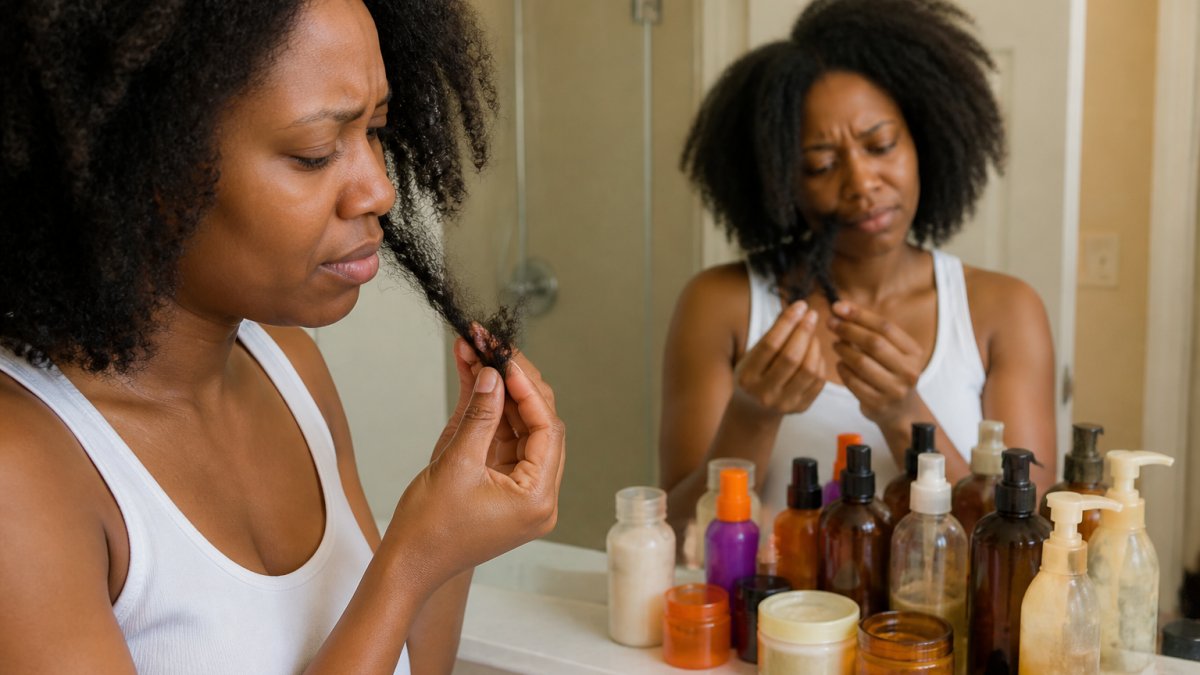
Signs of buildup include dull hair, white flakes at the roots, and products that sit on top of hair instead of sinking in. A toner like an apple cider vinegar cleansing toner helps remove residue between deep cleanses.
Ingredient Compatibility: When Your Products Fight Each Other
Two great products can cancel each other out. Ingredient compatibility is where most routines quietly break down, and the fix isn't buying more, it's stacking products in an order the chemistry supports.
The five ingredient classes that decide whether a routine works
Almost every natural hair product is built from a handful of functional classes. Knowing what each does tells you where it belongs in the stack and what it fights with.
- Humectants (glycerin, propylene glycol, honey, aloe vera, sodium PCA) pull water toward themselves. In humid air they keep hair pliable; in very dry air they can pull moisture out of the strand. They belong in water-based leave-ins and sprays on damp hair.
- Oils and butters (shea butter, coconut oil, castor oil, jojoba, olive oil) are sealants, not moisturizers. They slow water loss but don't add water. Applied over a water-based layer they lock it in; applied first they block the next layer.
- Proteins and protein derivatives (hydrolyzed wheat, silk, keratin, oat, rice) temporarily fill gaps in the cuticle and add strength. Fine or low-porosity hair can feel stiff when protein is layered too often; high-porosity hair tolerates more. Don't stack protein-heavy products back-to-back on the same wash day.
Combinations that commonly fail
- Heavy butter over a light water-based leave-in. The butter seals the cuticle before the leave-in absorbs, so hair feels greasy but dry underneath. Order matters more than amount.
- Silicone serum under a moisturizer. Non-water-soluble silicones (dimethicone, amodimethicone) form a film water-based products can't penetrate. Fine as a final step; used earlier they block everything after them.
- Gel over an unabsorbed cream. The polymer cast grabs the cream instead of the hair, leaving white flakes or rolled pills. Let each layer absorb for a minute or two before adding the next.
How to read an ingredient list in 30 seconds
Ingredients are listed in descending order of concentration until roughly the 1% mark. A quick scan:
- Find the first five ingredients, that is most of the formula.
- Note whether water is first (water-based, layer early) or an oil or butter is first (oil-based, layer late).
- Look for humectants in the top five to predict humidity behavior.
- Check for non-water-soluble silicones (ingredients ending in -cone or -conol, other than dimethicone copolyol or PEG-dimethicone) if layering water-based products on top.
- Look for protein words (hydrolyzed, amino acids, keratin, silk, wheat, rice) if your hair is prone to stiffness.
A simple compatibility rule
Layer thinnest to thickest and water-based to oil-based: water or spray, then water-based leave-in, then cream, then butter or oil, then styler. If a product pills or flakes, the problem is almost always order or absorption time, not the product. Give each layer a moment to sink in, and you'll eliminate most "these products hate each other" failures without buying anything new.
How to Moisturize Natural Hair So Products Actually Work
How to moisturize natural hair comes down to one rule: water first, always. Moisture is water. Oils and butters seal it in; they don't create it. Apply products to damp hair in this order:
| Step | Product | Purpose |
|---|---|---|
| 1 | Water or water-based spray | Adds actual moisture |
| 2 | Leave-in conditioner | Holds moisture in the strand |
| 3 | Cream or butter | Seals and softens |
| 4 | Oil | Locks the seal at the ends |
| 5 | Gel | Defines and holds style |
For hair that dries out fast, a rich formula made for tight textures gives coils the heavier hydration they need.
Layering Products in the Right Order
Layering isn't about using more product, it's about order: thinnest to thickest, water-based to oil-based. Skip this and your leave-in never reaches the strand. Apply each layer to small sections, smooth downward, then scrunch; raking product through randomly leaves the mid-shaft dry.
Your Natural Hair Wash Day Routine: Reset, Cleanse, and Rebalance
A natural hair wash day routine should reset the scalp, cleanse gently, and rebalance moisture, in that order. Wash day is where most routines succeed or fail.
- Pre-wash: apply a scalp treatment to loosen buildup and soothe irritation
- Cleanse: shampoo the scalp first, then let suds run through the ends
- Condition: detangle with conditioner and a wide-tooth comb
A pre-wash masque like an aloe butter scalp treatment preps the scalp before cleansing, especially helpful if you stretch wash days.
Itching, Flaking, and Scalp Health: When the Problem Starts at the Root
Itching, flaking, and dandruff often signal the problem isn't your hair at all. Scalp health drives product performance: an inflamed or coated scalp makes even a good moisturizer feel like it failed.
What actually causes the itch and the flakes
Flaking and itching usually come from one of four mechanisms, each with a different fix:
- Product residue and buildup. Oils, butters, gels, and dry shampoos not fully cleansed away coat the scalp, trap dead skin cells, and create white or yellowish flakes mistaken for dandruff. This is the most common cause in routines that stretch wash days.
- Dry scalp. Cold weather, indoor heat, and harsh cleansers strip natural oils, producing small, powdery flakes and tightness rather than greasy ones.
- Seborrheic dermatitis. An inflammatory condition linked to Malassezia yeast, producing greasy yellowish flakes, redness, and itching, often along the hairline and behind the ears. It isn't caused by poor hygiene and doesn't resolve with oil alone.
How to tell product-caused irritation from a medical issue
To separate the two, change one variable and watch for two to three weeks:
- Small, dry, powdery flakes that improve after a clarifying wash and a break from heavy oils point to product residue or dryness.
- Greasy, yellowish flakes that cling to the scalp and hairline, with itching that persists despite clean washing, suggest seborrheic dermatitis and deserve a dermatologist's look.
- Itching and redness that appear only after a new product should clear within two weeks of stopping it; if so, contact irritation is likely.
A scalp-first reset for natural hair
When itching and flaking start, treat the scalp before adding more moisture to the hair:
- Clarify once. Use a clarifying shampoo to remove residue, then assess the scalp for a few days.
- Cleanse the scalp, not just the hair. Shampoo belongs on the scalp; let suds run through the ends. Wash at least every one to two weeks if you use heavy butters or gels.
- Ease off heavy oils and butters at the root. Keep them on mid-lengths and ends. A lightweight scalp oil can soothe dryness, but thick butter or castor-oil-heavy blends at the root feed residue and can worsen yeast-related flaking.
- Avoid scratching. Scratching breaks the skin barrier and can introduce irritation or infection. Use fingertips, not nails.
- Patch-test new products. Apply a small amount behind the ear or on the nape and wait 48 hours before using it on the full scalp.
A lightweight scalp oil, such as a rosemary mint hair oil, can soothe everyday dryness without weighing down roots, but if flakes are greasy and persistent, oil is the wrong tool and a medicated shampoo is the right conversation to have with a dermatologist.
Why scalp health changes how products perform
An inflamed or coated scalp changes the environment hair grows from. Residue at the root can block water-based products from reaching the strand near the scalp, which is why the first inch often feels dry and rough while the ends feel fine. Clearing the scalp and cleansing regularly often restores product performance without changing a single product, which is why scalp health belongs at the top of any troubleshooting checklist.
How Your Hair Needs Change Over Time and Across Seasons
The routine that worked last winter may fail in summer. Hair needs shift with humidity, hard water, hormonal changes, diet, and age. A product that felt perfect in July can turn greasy in January's dry indoor heat.
Watch for these signals that your routine needs an adjustment:
- Hair dries out faster than usual
- Products that once absorbed now sit on top
- Your scalp itches more after wash day
Adjust one variable at a time: swap a butter for a lighter cream, add a humectant in humid months, or increase clarifying washes with hard water. Track results for a month before changing anything else.
Frequently Asked Questions
Why are my natural hair products not working anymore?
Products that worked before often stop because of buildup, reformulation, or a change in your hair's needs. Residue from oils, gels, and leave-ins can seal the cuticle so moisture never gets in. Product formulators also change ingredients without notice, and your porosity or climate may have shifted. Do a clarifying wash, then reintroduce one product at a time so you can see what actually changes.
Why is my hair not absorbing products even after I wash it?
If your hair repels water and product right out of the shower, the cuticle is likely coated or the hair is low-porosity. Use a clarifying shampoo to strip residue, then apply leave-in conditioner to damp, not soaking, hair and work it in sections with your fingers or a wide-tooth comb. Low-porosity hair benefits from warm water and lightweight, water-based products rather than heavy butters that sit on top.
Can product buildup make natural hair products less effective?
Yes. Natural hair product buildup creates a film that blocks moisture and active ingredients from reaching the strand. Silicones, heavy oils, and styling gels layer over time, especially if you co-wash only. A clarifying wash every four to six weeks, or more often if you use heavy stylers, removes the film and lets your regular products perform as intended.
How do I know if a product is wrong for my hair type?
Test one new product at a time for two to three weeks while keeping everything else in your routine the same. Watch for telltale signs: hair that feels coated, stiff, or dry after it dries, flakes at the roots, or curls that lose definition by day two. If those show up, the product is likely too heavy, too light, or incompatible with your porosity. Track what you used and how your hair responded so you can compare objectively.
Natural hair products fail when buildup, ingredient clashes, and shifting hair needs go unaddressed. We built Hair Naturally Beauty Supply to make that easier, with a curated selection made for 4A, 4B, and 4C textures, fast shipping, and a Black-owned team that understands the trial and error firsthand. Get started with Hair Naturally Beauty Supply and build a routine your hair actually responds to.