 how-to
How to Prevent Breakage on 4C Hair: 7-Step Routine
Table of Contents
- Start With the Difference Between Hair Shedding and Breakage
- How to Moisturize 4C Hair So Strands Stop Snapping
- How to Detangle 4C Hair Without Breakage
- Wash Day in Sections: The Step Most 4C Hair Breakage Starts In
- Deep Conditioning and Trimming: Your Split-End Defense
- Best Protective Styles for 4C Hair (and Which Ones Cause Breakage)
- Heat, Chemicals, and Over-Styling: The Damage You Can't Undo
- Conclusion
- Frequently Asked Questions
Last Updated: October 20, 2026
Start With the Difference Between Hair Shedding and Breakage
Before you buy another product, learn to tell shedding from breakage. Shedding is a full strand with a small white bulb at the root; breakage is a short piece snapping off mid-strand with no bulb.
Many women panic over normal shedding.
Here is how to prevent breakage on 4C hair: treat it as a moisture and handling issue, not a mystery. The fix starts with a routine, broken into seven steps below.
| Sign | Shedding | Breakage |
|---|---|---|
| Strand length | Full length | Short pieces |
| Root end | White bulb | No bulb, blunt or frayed |
| Where you see it | Comb, shower drain | Pillowcase, shoulders, sink |
| Main cause | Normal growth cycle | Dryness, friction, tension |
| What to do | Nothing, it is normal | Change handling and moisture |
How to Moisturize 4C Hair So Strands Stop Snapping
Dry 4C hair snaps. Coily hair struggles to move natural oils down the strand, so it dries out faster than straighter textures.
To moisturize 4C hair, apply water-based products to damp hair, then seal with an oil or butter to lock that water in.
Follow this order on damp hair:
- Spritz with plain water or a water-based leave-in.
- Work the product through each section with your fingers.
- Seal the ends with a light hair oil or butter.
- Repeat midweek, focusing on ends and edges.
Check the ingredient list: water should be first. Heavy mineral oil and petrolatum sit on top of the strand and block water.
How to Detangle 4C Hair Without Breakage
Detangling is where most length disappears. Wet hair stretches and snaps, and dry 4C hair tangles into tight knots. The safest window is damp hair loaded with conditioner and slip.
Finger Detangle First, Then Reach for the Wide-Tooth Comb
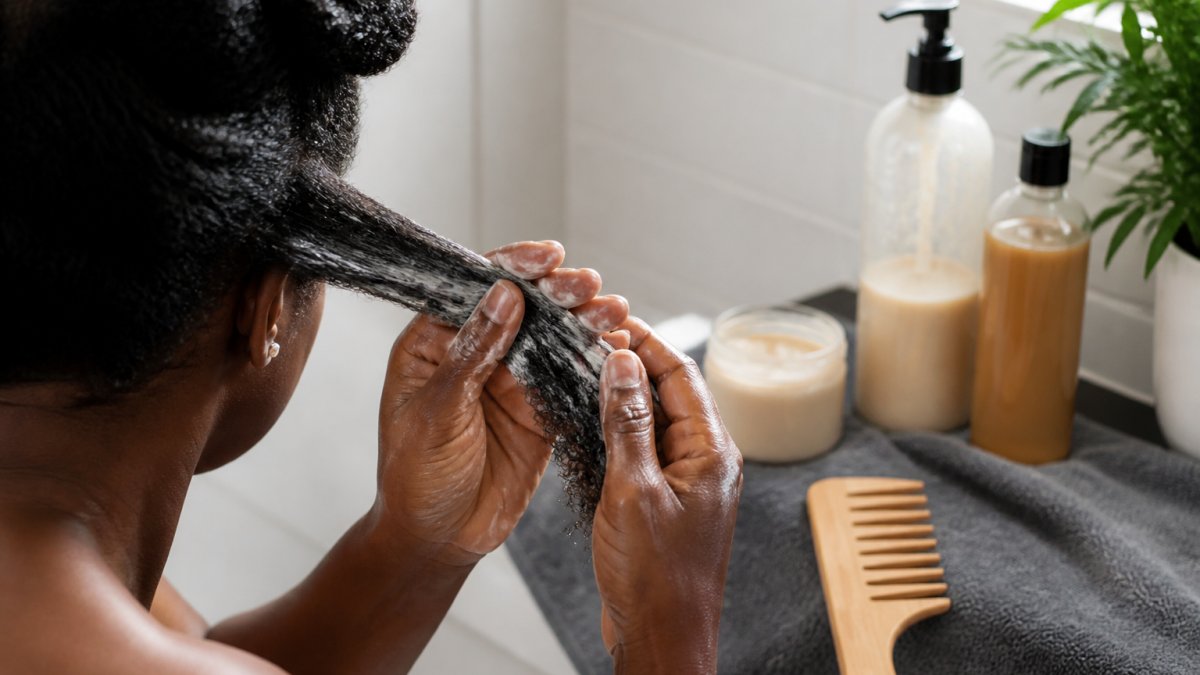
Start with your fingers, not a comb. Gently pull apart knots from the ends upward in small sections, and only reach for a wide-tooth comb once the section feels smooth.
Work in four to eight small sections. Rushing is the most common mistake, ripping through a tangle from the root down pushes the knot tighter and breaks the strand.
Keep these habits in rotation:
- Always detangle on damp, conditioned hair.
- Start at the ends and move up.
- Hold the section near the root so you do not pull the scalp.
Wash Day in Sections: The Step Most 4C Hair Breakage Starts In
Washing loose 4C hair in one big pile invites tangles and matting. Washing in sections keeps hair organized and cuts friction, braid or twist each section after cleaning and leave it until rinse time.
Shampoo only the scalp and let the suds run down the strands as you rinse. Then apply conditioner in the same sections and detangle each before rinsing.
Deep Conditioning and Trimming: Your Split-End Defense
Deep conditioning restores elasticity, what lets a coil stretch and return instead of snapping. Dry 4C hair has low elasticity: bend a shed strand and it barely stretches before breaking. A deep conditioner replenishes the lipids and humectants that keep the strand flexible, so combing and styling cause less mechanical damage.
Match the Treatment to What Your Hair Needs
Not every deep conditioner does the same job, and the wrong one can worsen breakage. Pick by need:
- Moisture (humectant) treatments list water, glycerin, aloe, honey, or panthenol near the top. Use these when hair feels dry, rough, and brittle and snaps without much stretch.
- Protein (strengthening) treatments list hydrolyzed wheat, silk, keratin, or rice protein. Use these when hair feels mushy, limp, or stretchy when wet, a sign the strand has lost structural integrity.
- Balanced treatments combine both and are the safest default for a weekly routine.
A common pattern is to alternate: moisture one wash day, protein the next. If hair feels stiff or straw-like after protein, you have overdone it, follow with moisture and space protein out to every four to six weeks.
How to Apply It So It Actually Penetrates
- Start on damp, clean hair, conditioner absorbs better without buildup.
- Section into four to eight parts and apply from mid-shaft to ends first, then upward.
- Comb through each section with a wide-tooth comb so product reaches every coil.
- Cover with a plastic cap to trap body heat and help penetration; a warm towel over the cap works too.
- Follow the label's time, typically 15 to 30 minutes. Longer does not add benefit and can over-soften hair.
- Rinse thoroughly; residual conditioner weighs hair down and attracts lint.
Trimming: The Only Real Repair for Split Ends
No product can glue a split end back together. Once the cuticle separates at the tip, the split travels up the strand, and the only fix is to cut above it.
- Full trim: every 8 to 12 weeks, or whenever ends look thin, rough, or see-through. Take off the damaged portion plus a small margin.
- Dusting: every 4 to 6 weeks, snip only the very tips (a few millimeters) to keep splits from forming between full trims.
- Search-and-destroy: on wash day, twist small sections and snip individual split ends you spot. This is maintenance, not a substitute for a full trim.
Trim on dry, stretched hair so you can see the true shape of the ends, wet 4C hair shrinks and hides splits. Use sharp hair shears, not household scissors, which crush ends and create new splits.
Best Protective Styles for 4C Hair (and Which Ones Cause Breakage)
The best protective styles for 4C hair keep ends tucked away with little tension on the scalp: two-strand twists, flat twists, loose cornrows, and buns with tucked ends.
Some styles do more harm than good. Tight braids, heavy extensions, and styles left in for months pull on the hairline and cause tension damage. If a style hurts when it goes in, it is too tight.
Tension, Edges, and Nighttime Protection
Your edges are the most fragile hair on your head. Constant pulling there leads to thinning that can be hard to reverse. Ask for looser braids and give your hairline breaks between styles.
Nighttime care matters just as much. Sleep on a satin pillowcase or wear a satin bonnet or scarf, cotton soaks up moisture and creates friction, drying and tangling hair overnight.
Heat, Chemicals, and Over-Styling: The Damage You Can't Undo
Most breakage advice focuses on dryness and detangling, but much 4C length loss comes from damage no moisturizer can reverse: heat, chemical processing, and tension. Knowing how each damages the strand tells you what to prevent and what is permanent.
Heat Damage: When the Cuticle Stops Recovering
Heat styling damages hair two ways. At moderate temperatures it temporarily reshapes hydrogen bonds, how a flat iron straightens coils, reversible with water. At high temperatures or with repeated passes, heat alters the cuticle's protein structure permanently: the section stays straight, limp, or rough even after washing and will not coil back.
Signs of permanent heat damage include straight patches that will not revert, a wiry or brittle texture, and split ends that appear soon after styling. Prevention is the only fix:
- Use a heat protectant every time, applied to dry hair before the tool touches it.
- Keep tools on the lowest setting that achieves the result. Fine, fragile 4C hair does better on lower heat with more passes than on maximum heat.
- Limit direct heat to occasional styling, not a weekly habit, and give hair rest weeks between sessions.
Chemical Processing: Overlap Is the Enemy
Relaxers and permanent color break bonds inside the strand to change shape or color, why they work, and why they weaken hair. Damage compounds when services overlap: relaxing colored hair, coloring freshly relaxed hair, or touching up processed sections all push the strand past what it can tolerate.
- Space chemical services at least four to six weeks apart, and longer if hair feels fragile.
- Never overlap relaxer on previously relaxed hair beyond the new growth, this is the most common cause of chemical breakage at the demarcation line.
- Tell your stylist about every chemical service in the past year, including box color and texturizers.
Tension and Extensions: The Damage You Feel Before You See
Tight braids, heavy extensions, glued-in tracks, and styles left in for months pull on the follicle and hairline. Tension damage shows up first as tenderness or bumps at the scalp, then thinning along edges and part lines. Unlike a split end, traction damage at the follicle can be permanent if pulling continues.
- If a style hurts when it goes in, it is too tight, ask for it to be redone looser.
- Give the hairline a break between protective styles; a common pattern is two to four weeks in a style, then at least a week out.
- Keep extension weight reasonable. Heavy braiding hair or long, dense tracks add constant pull.
Over-Styling: The Daily Accumulation
Over-styling is the quiet culprit because no single day does visible damage. Daily tight ponytails, repeated gelling and slicking, and constant combing add up through friction and tension. Low-manipulation styling, leaving hair mostly alone between wash days, tucking ends, and restyling less often, protects fragile strands. The goal is not zero styling, but fewer, gentler sessions with real rest in between.
Conclusion
Breakage on 4C hair is rarely about one bad product. It is dryness, rough handling, tight styles, and heat adding up over time. Build a routine around moisture, gentle detangling, sectioned wash days, regular trims, and low-manipulation styles, and your hair will hold onto length.
That is where we come in. Hair Naturally Beauty Supply is a Black-owned shop built for 4A, 4B, and 4C textures, with water-based moisturizers, deep conditioners, wide-tooth combs, satin bonnets, and braiding hair in one place.
Frequently Asked Questions
How can I tell the difference between hair shedding and breakage?
Shed hair comes out with a small white bulb at the root and is usually full-length, because it reached the end of its growth cycle. Breakage has no bulb and shows up as short fragments, often half the length of the rest of your hair. Do a quick check: collect strands after detangling and look at the ends. If you see mostly short pieces, that points to 4C hair breakage rather than normal shedding. Shedding 50 to 100 strands a day is typical; short snapped pieces are not.
How often should I trim 4C hair to prevent split ends?
Most 4C hair does well with a trim every 8 to 12 weeks, or sooner if you can feel rough, split ends when you run a strand between your fingers. Trimming does not make hair grow faster, but it stops splits from traveling up the strand and thinning your ends. Trim only what is damaged, usually a quarter inch to half inch. If you wear protective styles for long stretches, do a trim check between installs rather than waiting months.
Should 4C hair be oiled every day?
Daily oiling is not necessary and can backfire. Oil seals in moisture but does not add it, so layering oil on dry hair just coats the strand. A better routine: apply a water-based leave-in first, then a light oil to seal, two to three times a week or after wash day. If your scalp is oily or prone to buildup, oil the scalp less often. Heavy daily oiling can also weigh down fine 4C strands and make detangling harder.
Which protective styles are least likely to cause 4C hair breakage?
Two-strand twists, flat twists, and loose braids without extensions are the gentlest options because they use your own hair and keep tension low. If you use extensions, ask for a braid pattern that avoids pulling at the hairline and keep the install loose enough to slide a finger under the root. Avoid styles that stay in longer than 6 to 8 weeks, and never sleep on a fresh install without a satin scarf or bonnet. Take the style down gently, with conditioner, never dry.