 ultimate-guide
How to Moisturize 4C Hair: A 2026 Step-by-Step Guide
Table of Contents
- Why 4C Hair Loses Moisture So Quickly
- The LCO vs LOC Method for 4C Hair: Which One Works for You
- How to Deep Condition 4C Hair for Maximum Hydration
- Signs of Moisture Overload in 4C Hair (and How to Fix It)
- Step-by-Step: How to Moisturize 4C Hair Without Breakage
- How Climate, Scalp Health, and Internal Factors Affect Moisture Retention
- Choosing the Right Products for 4C Hair Moisture Retention
- Protective Styling and Daily Maintenance for Lasting Moisture
- Where to Find Products That Actually Work for 4C Hair
- Frequently Asked Questions
Last Updated: September 17, 2026
Why 4C Hair Loses Moisture So Quickly
If you have 4C hair, you know the pattern: you moisturize in the morning, and by afternoon your coils feel like straw. This isn't a product failure, it's structural. The tighter the coil pattern, the harder it is for scalp oils to travel down the shaft, so moisture must be added manually and sealed deliberately. Understanding how to moisturize 4C hair starts with accepting that your hair will never self-lubricate like looser textures.
How Porosity Affects Your Hair's Ability to Hold Water
Hair porosity measures how easily your cuticle layer absorbs and retains water. Low porosity hair has tightly closed cuticles that resist absorption, so products sit on top. High porosity hair has raised, damaged cuticles that absorb water fast but lose it just as quickly. Most 4C hair falls in the middle, but heat damage, chemical processing, and mechanical stress push you toward high porosity over time.
The LCO vs LOC Method for 4C Hair: Which One Works for You
The LCO vs LOC method for 4C hair comes down to one variable: whether your cuticle absorbs water easily or repels it. Both layer liquid, cream, and oil, but the sequence changes everything.
Method | Best For | Order | Why It Works |
|---|---|---|---|
LCO | High porosity, damaged hair | Water → Cream → Oil | Cream buffers before sealing |
LOC | Low porosity, product buildup | Water → Oil → Cream | Oil traps water before cuticle closes |
The Product-Layering Science Most Guides Skip
Water-based leave-ins and oil-based sealants don't just stack, they interact. A water-based leave-in is an emulsion: water droplets suspended with humectants, emollients, and sometimes light silicones. On damp hair, humectants (glycerin, honey, aloe) pull water into the cortex while emollients coat the cuticle and slow evaporation.
How to Tell Which Method Your Hair Wants
Don't guess from a porosity quiz alone. Run this two-week test:
- Week one, LCO. Cleanse, then apply water, cream, oil in that order. Note how your hair feels on days one, two, and three.
- Week two, LOC. Same cleanse, same products, oil before cream. Track the same three days.
What you're looking for:
- If LCO leaves hair greasy and coated by day two, your cuticle is too tight for the cream to penetrate, you're low porosity and LOC will serve you better.
- If LOC leaves hair dry and brittle by day two, water escaped before the cream could seal it, you're high porosity and LCO is the fix.
- If both feel roughly the same, you're likely medium porosity. Default to LCO in winter and LOC in summer.
How to Deep Condition 4C Hair for Maximum Hydration
Deep conditioning is where real moisture retention gets built, not maintained. Treat it as a targeted treatment, not a weekly checkbox.
Signs of Moisture Overload in 4C Hair (and How to Fix It)
Signs of moisture overload in 4C hair look deceptively like healthy hydration, which is why so many people miss them. The tell is texture, not feel. Watch for:
- Hair feels mushy or spongy when wet, like overripe fruit
- Strands stretch significantly without snapping back
- Curl pattern loosens or looks limp and stringy
- Hair takes unusually long to dry
- Breakage happens when hair is wet, not dry
Moisture overload means your hair has absorbed more water than its protein structure can support, weakening the cuticle and collapsing elasticity. The fix is a protein treatment, not more conditioner. Look for hydrolyzed wheat, rice, or silk protein and use every four to six weeks until elasticity returns. Once hair snaps back when stretched, resume your normal moisture routine.
Step-by-Step: How to Moisturize 4C Hair Without Breakage
Here's the sequence that works, in order. Skipping or rearranging steps is the most common reason moisture routines fail.
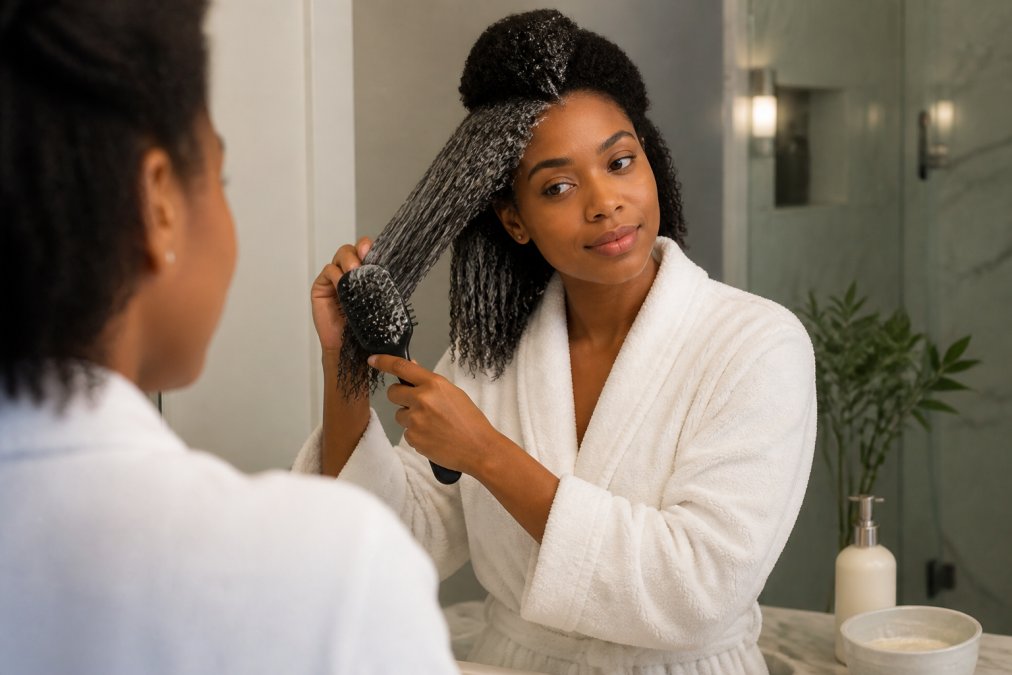
Black woman applying leave-in conditioner to moisturize 4C hair at a vanity with hair care products nearby.
Finger Detangling Before You Apply Anything
Never apply product to tangled 4C hair. Finger detangling first prevents the breakage that happens when combs drag through dry, knotted coils. Work in small sections, ends to roots, using a light mist of water or slippery conditioner for glide. It takes longer than combing but preserves length. A common mistake is rushing this with a wide-tooth comb on dry hair, which snaps strands at the weakest point.
Layering Water, Leave-In, and Sealant in the Right Order
Work section by section using this sequence:
- Spritz with water until hair is damp, not soaking
- Apply a water-based leave-in conditioner and distribute with fingers
- Add a cream moisturizer for coarse hair types
- Seal with a light oil or butter, focusing on ends
- Twist or braid each section to hold moisture while it sets
The water is non-negotiable. Oil and butter alone cannot hydrate hair, they only seal what's already there, so applying sealant to dry hair traps dryness in. For daily refresh, mist with water and re-seal only the ends.
How Climate, Scalp Health, and Internal Factors Affect Moisture Retention
Most 4C guides treat moisture as a purely topical problem. It isn't. Three variables, climate, scalp biology, and internal health, determine how much of your routine actually sticks.
Climate: Why Your Routine Fails in February and Works in July
Hair is hygroscopic, it exchanges water with the air around it, in both directions, depending on relative humidity.
Scalp Health vs. Hair Shaft Moisture: Two Different Problems
This is the distinction most guides blur. Your scalp and hair shaft have different moisture needs, and treating them the same causes most of the frustration people blame on products.
Internal Factors: Diet, Hydration, and Stress
Hair is one of the last tissues your body prioritizes for nutrients. If you're deficient, your hair shows it first.
Choosing the Right Products for 4C Hair Moisture Retention
Read labels for these ingredients, and match them to your porosity:
- Humectants: glycerin, honey, aloe vera. Pull water into hair from the air. Best in humid climates; can backfire in dry air.
- Emollients: shea butter, coconut oil, avocado oil. Soften and add slip.
- Proteins: hydrolyzed rice, wheat, or silk protein. Use for strength and to correct moisture overload.
- Sealants: castor oil, jojoba, and heavier butters. Lock moisture in last.
Protective Styling and Daily Maintenance for Lasting Moisture
Protective styles reduce manipulation, and less manipulation means less breakage and slower moisture loss. Two-strand twists, flat twists, and cornrows keep ends tucked away where they can't rub against clothing or dry out. Moisturize before you install the style, not after. Once hair is braided or twisted, reapply moisture by misting the scalp and sealing the parts rather than saturating the style itself.
Where to Find Products That Actually Work for 4C Hair
Hair Naturally Beauty Supply exists for exactly this problem. As a Black-owned online beauty destination, we curate hair care, braiding hair, wigs, and styling tools specifically for 4A, 4B, and 4C textures, so you're not guessing whether a product was designed with your hair in mind. Every item is selected for coily, curly, and natural hair needs, and we ship fast so your routine never stalls.
Frequently Asked Questions
Why is my 4C hair so dry even after moisturizing?
4C hair's tight coil pattern makes it hard for natural oils from your scalp to travel down the hair shaft. If you apply water-based products without sealing them in, the water evaporates and leaves your coils drier than before. The fix is layering: water first, then a leave-in conditioner, then an oil or butter to seal. Check your hair's porosity too. High-porosity 4C hair loses moisture faster and needs heavier sealants like shea butter, while low-porosity hair does better with lighter oils and more frequent spritzing.
How do I tell if my 4C hair is properly moisturized?
Moisturized 4C hair feels soft and flexible when you bend a strand, not stiff or brittle. It has some natural sheen rather than a dull, ashy look. When you stretch a coil gently, it should bounce back without snapping. Another sign is that your hair stays soft for two to three days after washing, not just a few hours. If your coils feel crunchy, rough, or shed more than usual during detangling, your moisture-protein balance is likely off.
What is the LCO method for 4C hair?
LCO stands for Liquid, Cream, Oil. You apply a water-based product first, follow with a cream leave-in conditioner, then seal with an oil or butter. This order works best for high-porosity 4C hair because the cream adds a layer of moisture before the oil locks everything in. LOC reverses the last two steps: Liquid, Oil, Cream. LOC suits low-porosity hair because the oil layer helps water penetrate before the cream sits on top. Try both and see which keeps your coils softer longer.
How often should you deep condition 4C hair?
Deep condition 4C hair once a week if your hair is dry, damaged, or transitioning. If your hair is healthy and well-moisturized, every two weeks works fine. Use a moisturizing deep conditioner with humectants like glycerin or honey for hydration, and a protein deep conditioner once a month if your hair feels limp or stretchy. Always follow with a cool water rinse to help close the hair cuticle and lock in the treatment.